


TL;DR
- Trust is no longer built in branches; it’s built in feeds, search results, and AI answers
- Financial brands now compete with content creators, not just competitors
- Credibility is driven by clarity, proof, and presence across channels
- Winning brands build trust across channels; in-branch to in-app, social, and AI-driven discovery
Trust has always mattered in financial services. But the way it’s built has changed.
Today’s audiences don’t start with a banker, a brochure, or a branch visit. They start with a search, a scroll, or a creator they already trust, and stay when there are visible signs of trust across the customer journey.
This shift is redefining what credibility in financial marketing actually looks like.
Credibility is the new currency in financial services marketing
Money is personal. Which means trust isn’t optional. Trust is everything.
In a world where answers are instant and opinions are abundant, financial brands are no longer just competing for attention. They are competing for belief.
This shift matters because trust is still earned the same way it always has been: through clarity, consistency, and proof. What’s changed is how and where it’s delivered. For a data-driven look at what is working right now, see our State of Credit Card Marketing report.
Today, trust is built through intentional, visible signals woven into every interaction, from transparent disclosures to real customer stories and consistent digital experiences.
Before someone chooses a financial institution or opens an account, they ask themselves a simpler question:
“Do I trust this?”
Increasingly, that answer is formed long before a brand ever enters the conversation.
Studies consistently show that most consumers research financial decisions online before speaking to a human. Younger audiences are leading that shift, with nearly 80% of Millennials & Gen Z turning to platforms like YouTube and TikTok for financial advice (PYMNTS.com, 2024).
Where people go for answers (and why it matters)
The journey to financial understanding has moved far beyond traditional, formal financial education.
For a closer look at how financial education marketing is evolving, explore our latest insights.
For many audiences, learning about money now looks like:
- Watching a 30-second breakdown on TikTok
- Comparing perspectives on YouTube
- Scanning search results late at night
- Asking questions through AI tools
A growing number of younger users now treat social platforms as search engines. Many turn to creators before institutions when they need something explained quickly and clearly.
These new search behaviors have raised the stakes for financial marketers. Audiences aren’t waiting to be taught. They’re actively learning, questioning, and making decisions in public.

Stop guessing what builds trust.
Download our guide for measuring credibility, not just clicks.
Get the ROI Reframe guideThe new first impression for financial brands
For financial brands, the first touchpoint isn’t what it used to be.
Not a home page. Not a product page. Not even a conversation.
Now it’s a moment: a short video, a search result, a creator explaining a concept, or a single post that either makes something click – or doesn’t
That window is tiny. You have seconds, not minutes, to establish clarity and confidence.
If you don’t, someone else will.

What hasn’t changed
For all the changes in channels, the psychology of trust remains the same.
People still look for signals that tell them something is credible, relevant, and worth acting on.
Trust is no longer built top-down. It is built laterally, through creators, communities, comments, and shared experience.
The work of Robert Cialdini helps explain why.
The voices that resonate tend to tap into a familiar set of what Cialdini calls “persuasion triggers”:
- Reciprocity: quick tips, tools, and templates.
- Liking: a relatable face, tone, or style.
- Social proof: comments, shares, screenshots, and testimonials.
- Authority: niche expertise or lived experience.
- Scarcity: urgency around timing or access.
- Commitment and consistency: recurring series and repeated engagement.
- Unity: language that signals shared identity and common circumstance.
This helps explain why financial creators (“finfluencers”) have gained traction so quickly.
They don’t just share information. They make it understandable, repeatable, and relevant.
Financial brands aren’t just competing with other financial institutions. They’re competing with people and platforms reaching audiences earlier in the journey.
Why this matters for financial services marketers
Financial brands already own authority. They just need to express it differently.
Credibility is no longer a static brand trait to be declared. It is a living system demonstrated over time and across touchpoints, built through proof, relevance, and repetition.
That means creating content that:
- Answers the exact questions people are asking
- Uses plain language instead of jargon
- Shows expertise without feeling inaccessible
- Comes from a messenger the audience can relate to
- Builds proof through examples, data, and third-party validation
- Shows up where people are already searching, scrolling, and learning
Your brand isn’t being evaluated in isolation. It is constantly being compared to content that is:

Simpler

Faster

More relatable

Easier to Understand
If your content feels slow, complex, or hard to follow, it won’t just underperform, it will create skepticism. And skepticism is the gateway to distrust.
What to do about it
The brands that will win in the Credibility Era won’t be the loudest. They’ll be the clearest, most aligned with how people actually learn today, and have intentional trust signals embedded across the customer journey.
IN PRACICE, THAT MEANS:


The bottom line
Expectations around financial education have changed. The Credibility Era has begun.
People don’t just want accurate information. They want information they can understand, trust, and act on quickly.
The brands that adapt to this won’t feel louder. They will feel clearer and display intentional trust signals throughout the customer journey.
In financial marketing, clarity earns trust long before an actual conversation ever begins. Credibility retains customers long after the first transaction fades.
We created the Financial Influence Playbook that makes it easy to build credibility at every touchpoint and can be adapted to any channel, audience, or stage of the customer journey.
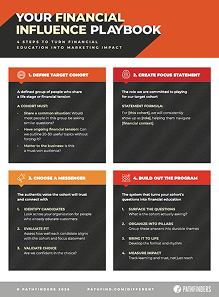
Financial Influence Playbook: A 4-step framework for building credibility and influence in the social channels shaping financial decisions today.
Subscribe to "Pathfinder" for financial insights and strategies, so you can focus on driving results where it matters most.
SubscribeShare:

Insight brought to you by: Kelly Ball, Chief Executive Officer